Japan’s Rising Sun flag was the official military flag of
Japan during World War II and now has connotations abroad, especially in South
Korea, as a symbol of Japanese militarism, although it is also a symbol of
Japanese patriotism in Japan. Currently, the flag is flown during many Japanese
anti-Korean right-wing groups’ rallies and marches. Late last month, South Korean
lawmaker An Min-suk explained a resolution proposed to the South Korean National
Assembly to Seoul media, equating Japan’s Rising Sun flag with the swastika
flag of Nazi Germany in terms of symbolism of wartime militarism. A different
resolution was passed in the South Korean National Assembly calling for the ban
of the Rising Sun flag in the 2020 Olympics with only 3 members dissenting. However,
this view is not shared by some Japanese lawmakers and the Foreign Ministry,
who see the Rising Sun flag as “widely accepted in the international community”
and not a symbol of militarism or of political
views.
But the problem is wider than just the 2020 Olympics—the
Rising Sun flag still remains a symbol of Japanese militarism during World War
II in many East Asian countries, although South Korea is the only one to make an
issue out of the flag. Although Japanese colonialism in Japan forced Korea to
advance rapidly technologically, direct military rule for the first ten years
of occupation meant that any Korean dissent was met with military opposition.
Japanese colonial rule of Korea ended in 1945, almost 75 years ago, but there
are still many war victims in South Korea and China, some of whom are rape victims
of Japanese troops during the war.
Recently, in the popular anime Kimetsu no Yaiba, the main character Tanjiro’s hanafuda-inspired
earrings were altered for the version airing in mainland China to avoid any potential controversy because the earrings bear resemblance to the Rising Sunflag, according to Taiwanese site NewsGamme.
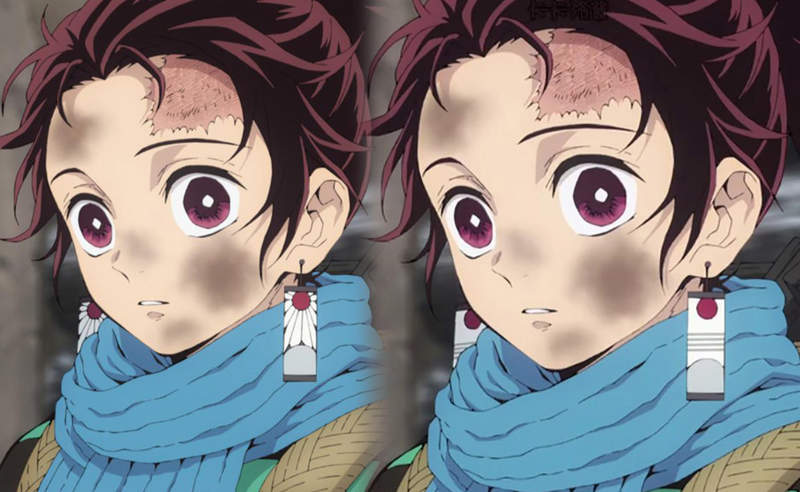
Afterwards, there was a push online, especially from
Twitter, asking all Kimetsu no Yaiba
fanartists to draw Tanjiro’s earrings as the alternate version aired in China. However,
this movement also received strong opposition from those claiming that the symbolism
of the earrings was not drawn from the Rising Flag’s modern connotations or
that the effect of the symbolism was not strong enough for some Asian
populations for the movement to have reason. The tweets of @insatiablejudge,
one of the ones who called for fanartists to draw the alternate versions of the
earrings, have since been protected, though the original tweet can be seenscreenshotted in a criticism of @insatiablejudge.
Reddit user Turnonegoblinguide claims that despite the
associated imagery, there is no reason to call to change for the earrings due
to the value of the Rising Sun flag as a symbol of Japanese patriotism and
because the original author of the manga and those working on the anime do not
seem to be promoting Japanese imperialism:
“I don’t think there’s any reason to have an arbitrary
censorship of a symbol for having negative connotations in the modern era when
the anime:
1. clearly takes place in an era when this
connotation doesn’t exist and
2. doesn’t have any kind of related hidden agenda
or propaganda as far as I can see
3. could potentially change the world misconception
of the rising sun as simply a symbol of Japanese patriotism”
However, there is no hanafuda card with a similar pattern,
and there has been no statements from the author concerning this.
This online discourse, coupled with the South Korean call to
shows that while some groups, primarily in East Asia, see the Rising Sun flag
as a symbol of Japanese imperialism, those in Western circles often do not see the
significance or how it could be interpreted as something harmful to those who
live in countries that have been affected by Japanese imperialism. The reaction
of Westerners could be chalked up to just “ignorance” but more specifically
likely results from an ignorance that stems from lack of Western education
about the long-lasting impacts Japan had during World War II. In particular,
the U.S. education system ignores, for the most part, the effects of international
wars in countries other than the United States. I myself did not learn about
the Rising Sun symbolism until hearing about it through Kimetsu no Yaiba Twitter.
Links


No comments:
Post a Comment